FOLK COSTUME OF TERCHOVÁ

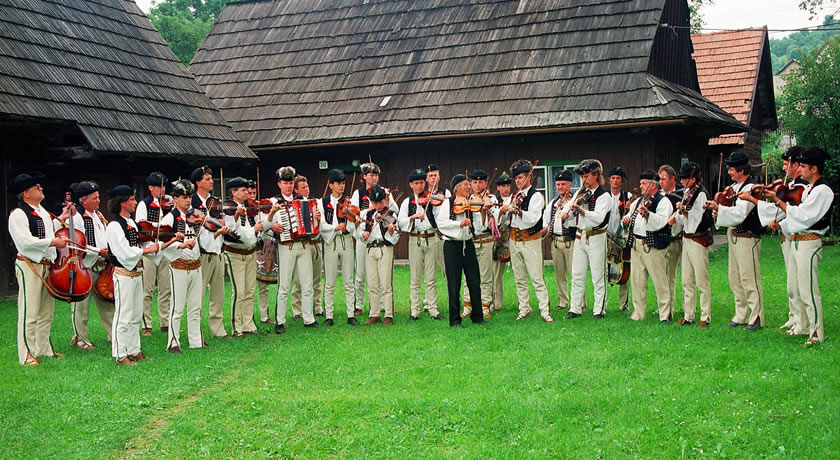
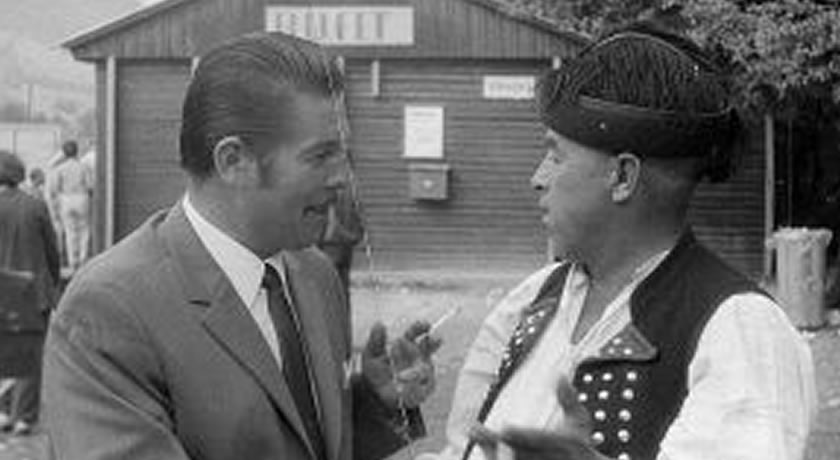
It is still possible to admire the traditional folk costumes at numerous events in Terchová and its surroundings. Male costume consisted of: a shirt without embroidery with a stand-up collar, white linen pants with two slits, a belt, a vest (“kabatek / lajblík”), a small fur coat (brusliak). In the winter they used to wear a three-quarter thick brown fur coat called huňa and peasant's shoes, high felt boots (kopitcá) or clodhoppers (baganče). On their head they would wear a small low hat with a visor curved upward or a brown leather cap. Female costume consisted of: a slip, a shirt (oplecko), a skirt (šorc) sewn to the bodice (lajblík), a working apron or a festive apron, a scarf. On the neck they used to tie a special triangular scarf (skosa). In the winter they used to wear a three-quarter white coat, a short broadcloth smock and a tight jacket. They would wear peasant's shoes, soft boots or high broadcloth slippers. Girls used to wear their hair in one braid with center parting (pútec). Married women would wrap their hair around the head and support it with a pad (choľma) made of straw and linen. Since the mid-20th century these pads have no longer been worn. On the hair they

DIALECT OF TERCHOVÁ

The dialect of Terchová belongs to the group of central Slovak dialects and it is very similar to the Orava dialect. It is renowned for being funny and has its own small bilingual dictionary (Terchová dialect - Slovak) containing some typical words such as hárešť (prison), huzňe (pants) or reforms (women's panties).

MUSIC OF TERCHOVÁ

It is said that there are the most musicians and singers per square meter in Terchová. This is evidenced by the fact that in each house there is a musician, and each of the settlements used to have its own music. The "heavenly" music of Terchová is archaic folk music existing in Terchová and surrounding villages. It is characterized by a 3-4-member ensemble with a small two-string double bass. Typical is polyphonic singing of all musicians. The music of Terchová has always been closely connected with dance, therefore its style is pretty lively and jolly, with quick interludes and slower passages of singing. Listing the music of Terchová in the World List of the Intangible Cultural Heritage of Humanity by UNESCO in 2013 is a tribute to all generations of people from Terchová and its surroundings who have preserved ancestral treasures for the contemporary world and Terchová´s visitors.

SHEEP FARM (SALAŠ)

The Fatra culture is inextricably linked to shepherds and sheep-farming since the 15th century, when the territory of the region was colonized by the Vlachs who easily integrated into the local population. It is possible for a visitor to see a shepherd milking sheep or producing cheese in several places. The sheep farm in the pass between Terchová a Zázrivá called Rovná hora is available all year round. This sheep farm is exceptional for plenty of attractions ranging from farming of sheep and other domestic animals, an exhibition of shepherd´s work, the opportunity to watch the production of genuine Zázrivá korbáčiky (braided string cheese) and bryndza (a type of sheep cheese), through horseback or carriage rides to the tour of a typical shepherd´s hut with traditional home cuisine and accommodation. Shepherds in the Vrátna Valley run the sheep farm seasonally from May to the end of summer. Here you can purchase the tasty May bryndza, sheep cheese or whey. The sheep farm can be found on the right side of the road to Vrátna between the intersection to Štefanová and Starý dvor.

logo_programu_custom

QUALIFIED TOURISM PORTAL created within the project "Bodybuilding - jointly strengthen cultural, tourism and sport in Terchova, Bela and Jaworze."

logo_programu_custom

The project is co-financed by the European Union from the European Regional Development Fund and Cross-Border Cooperation Programme Poland - Slovak Republic 2007-2013.

Go to Top